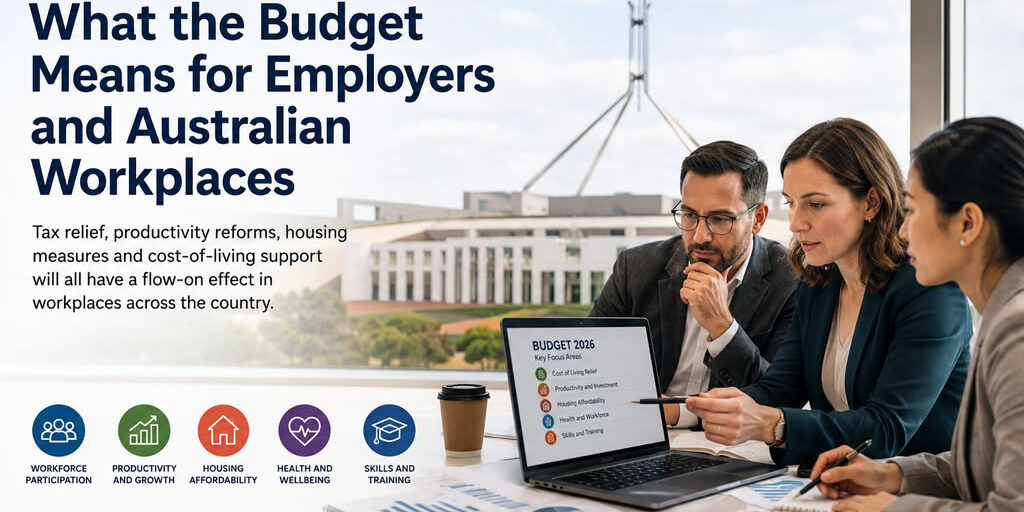
he Australian Federal Budget delivered this week was dominated by housing affordability, cost-of-living relief, healthcare investment, and productivity reform. But beyond the political headlines, the Budget also carries significant implications for employers, HR professionals, and workplace planning across Australia.
For businesses already navigating skills shortages, rising operational costs, AI disruption, and ongoing compliance pressures, the Budget signals a continued shift toward workforce resilience, productivity, and economic participation.
The message from Canberra is increasingly clear:
Employers are expected to play a larger role in supporting economic stability, workforce participation, training, and flexibility.
The Real Workplace Story Behind the Budget
While public attention focused heavily on housing tax reform and cost-of-living measures, HR and business leaders should be paying close attention to several underlying themes emerging from the Budget:
- Labour participation remains a national priority
- Productivity concerns are intensifying
- Skills shortages continue across multiple industries
- Healthcare and wellbeing remain linked to workforce capacity
- AI and automation pressures are accelerating workplace transformation
- Small and medium businesses are under increasing compliance pressure
Taken together, these trends point toward a workplace environment where employers will face growing expectations around retention, flexibility, workforce planning, and operational efficiency.
Cost-of-Living Pressures Continue to Impact Workplaces
Although the Budget introduced further tax relief and household support measures, many employees remain under significant financial stress.
For employers, this matters more than many realise.
Financial pressure increasingly affects:
- Employee engagement
- Retention
- Mental health
- Productivity
- Absenteeism
- Workplace conflict
Many HR teams are already reporting higher levels of burnout and financial anxiety among employees, particularly in sectors affected by housing affordability pressures and rising living costs.
This is likely to accelerate demand for:
- Flexible work arrangements
- Salary reviews
- Additional wellbeing initiatives
- Financial wellness support programs
- Employee assistance services
Organisations ignoring these pressures may face growing retention risks over the next 12–24 months.
Productivity Will Become a Major Workplace Focus
One of the strongest themes underpinning the Budget was Australia’s productivity challenge.
This has direct implications for employers.
Businesses are increasingly being pushed to improve efficiency through:
- Technology adoption
- AI integration
- Process automation
- Workforce upskilling
- Better leadership capability
- Smarter workforce planning
But productivity improvement is becoming more complex in modern workplaces.
Employees are demanding flexibility and wellbeing support at the same time organisations are seeking higher output and operational efficiency.
This creates a difficult balancing act for leadership teams.
The organisations that succeed will likely be those that improve systems and leadership capability rather than simply increasing pressure on employees.
AI Governance Is Quietly Becoming an HR Issue
Although AI regulation was not the central focus of the Budget, the broader economic direction reinforces the growing importance of workplace technology governance.
More organisations are now deploying:
- AI-assisted recruitment tools
- Automated performance monitoring
- AI productivity systems
- Workforce analytics platforms
- Generative AI workplace tools
This creates growing legal, ethical, and cultural risks for employers.
HR departments are increasingly expected to participate directly in AI decision-making — particularly where systems may impact:
- Hiring fairness
- Privacy
- Surveillance
- Employee performance management
- Bias and discrimination risks
- Psychological safety
This is rapidly evolving from an IT issue into a workforce governance issue.
Housing Affordability Is Now a Workforce Issue
The Budget’s housing measures also have broader workplace implications.
Housing affordability increasingly affects:
- Recruitment
- Relocation
- Workforce mobility
- Regional employment
- Retention
- Salary expectations
Many businesses are finding it harder to attract workers into high-cost metropolitan areas unless flexible or hybrid arrangements are available.
This trend is likely to continue reshaping workforce structures across Australia.
HR Compliance Complexity Continues to Grow
Even where the Budget does not directly legislate workplace reforms, employers should expect continued regulatory complexity across areas including:
- Psychosocial safety obligations
- Wage compliance
- Contractor classification
- Casual employment rules
- Privacy and data protection
- AI governance
- Flexible work rights
For HR professionals, this means the administrative and compliance burden is unlikely to ease anytime soon.
Businesses without modern HR systems, updated policies, and structured workplace processes may increasingly struggle to keep pace.
What Smart Employers Will Focus On Next
The most proactive organisations are unlikely to wait for future regulation before acting.
Many are already investing in:
- Leadership development
- Workforce planning
- AI governance frameworks
- Policy modernisation
- Flexible work strategies
- Skills development
- HR automation and compliance systems
The focus is shifting from reactive HR management toward strategic workforce governance.
That transition is no longer optional for many businesses.
Final Thought
The Federal Budget may have been framed around economics, housing, and productivity — but its long-term impact will be felt heavily inside Australian workplaces.
For HR leaders and employers, the challenge is no longer simply managing staff.
It is managing change.
And in an environment shaped by rising expectations, technology disruption, compliance pressure, and workforce transformation, organisations with strong leadership and modern HR systems will be significantly better positioned for what comes next.
HR-INFO Resources
For organisations reviewing workplace policies, leadership capability, AI governance, compliance frameworks, or workforce management systems, explore the professional HR resources available at HR-INFO.