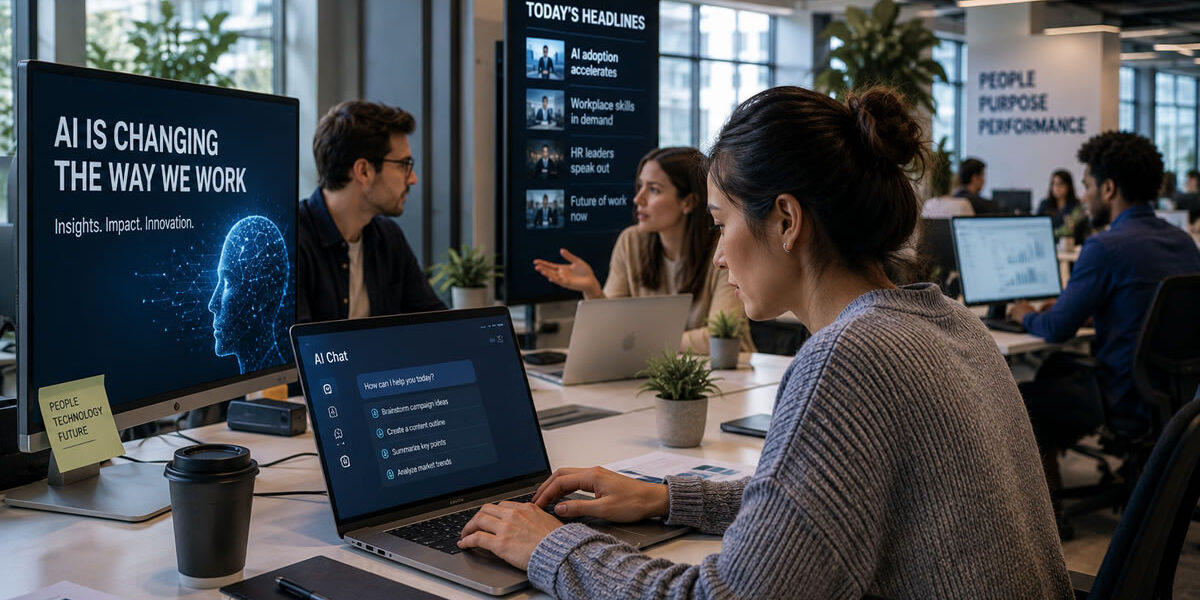
Artificial intelligence is moving through workplaces at extraordinary speed. New AI-powered tools are appearing almost weekly, promising greater efficiency, faster decision-making, improved productivity, and reduced operational costs. Organisations across Australia are rapidly experimenting with AI-assisted recruitment, automated workflows, employee analytics, content generation, customer service systems, and workplace productivity platforms.
Yet amid the excitement surrounding AI adoption, an increasingly important question is beginning to emerge:
Are employees keeping up?
For many organisations, the answer appears uncertain.
While businesses continue accelerating technology investment, workforce readiness is struggling to keep pace. Employees are frequently expected to adopt new systems with limited training, unclear policies, and little understanding of how these technologies may ultimately affect their roles.
This is creating a growing disconnect between technological capability and human capability.
The assumption that employees will naturally adapt to new technologies is not new. However, the speed at which AI is evolving has created challenges many organisations have not previously encountered. Workers are increasingly reporting uncertainty around how AI tools should be used, what information can safely be entered into systems, and whether these technologies are designed to support them or eventually replace them.
For HR teams, these concerns are becoming difficult to ignore.
Beyond the technical implementation itself, organisations are increasingly encountering broader workforce questions surrounding trust, communication, training, and job security. Employees are asking whether AI will change career pathways, alter performance expectations, or create new forms of workplace monitoring.
At the same time, employers remain under pressure to improve productivity and remain competitive in an increasingly digital economy.
This creates a difficult balancing act.
Businesses want faster adoption. Employees want clarity and reassurance.
Increasingly, HR finds itself positioned between both sides.
Rather than simply facilitating technology rollouts, HR departments are now being asked to help organisations navigate the human side of AI adoption. That includes workforce education, change management, communication strategies, and helping leadership teams understand the potential impact on workplace culture.
The challenge is not necessarily whether AI will become part of the workplace.
That question has largely been answered.
The real challenge may be whether organisations can bring their people with them.
Because while technology can be deployed quickly, trust often moves at a much slower pace.
This article was published by HR-INFO, Australia’s long-standing human resources and workplace information resource, providing practical insights, HR solutions, and workplace guidance for employers and HR professionals.