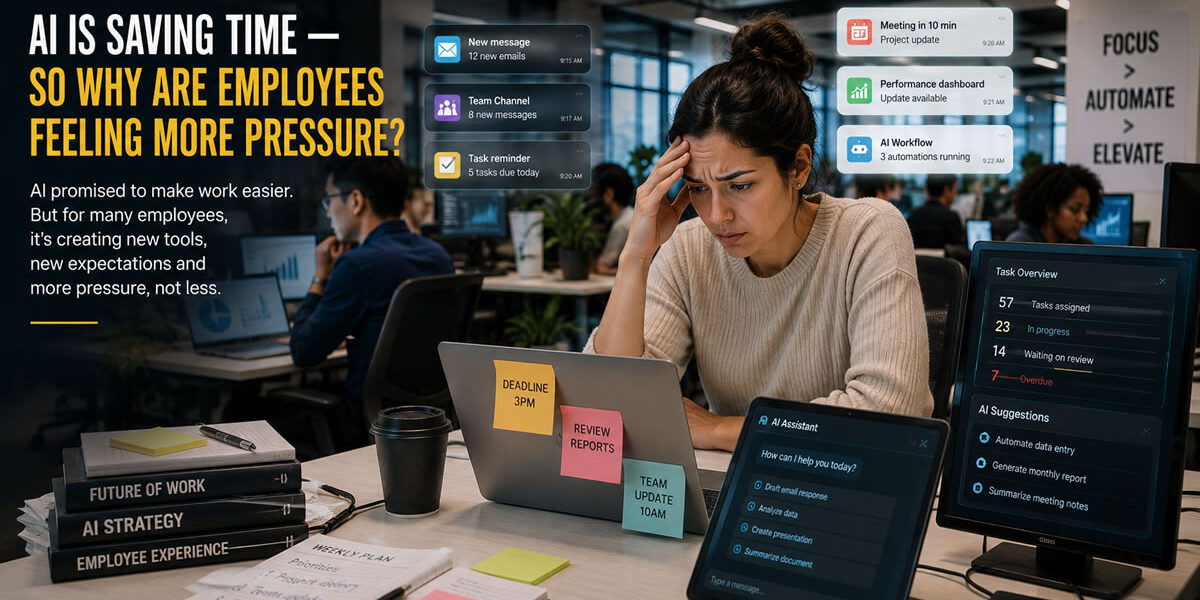
Artificial intelligence was supposed to simplify work.
The promise was compelling: automate repetitive tasks, reduce administrative burden, improve efficiency, and allow employees to focus on more meaningful and higher-value work. Yet for many employees, the workplace reality is beginning to look far more complicated.
As AI tools become embedded into daily work, many organisations are finding that technology implementation alone does not automatically create a better employee experience. New research suggests AI users often report mixed feelings around productivity, while some employees are questioning whether they are actually achieving more despite spending increasing amounts of time interacting with AI systems.
For some workers, AI has become another platform to monitor, manage, learn, and adapt to rather than a tool that removes complexity.
Employees are increasingly navigating multiple AI assistants, automated workflows, productivity dashboards, and digital collaboration systems simultaneously. While some report strong productivity gains, others describe feeling pressure to work faster, respond quicker, and produce more output simply because technology appears capable of accelerating tasks.
HR teams are increasingly finding themselves caught between enthusiasm and uncertainty.
Businesses continue pursuing productivity improvements and competitive advantage through AI investment, while employees are asking a different question:
“If technology is saving time, why does work sometimes feel more intense?”
There may not yet be a simple answer.
Part of the challenge may be that workplace technology evolves faster than workplace habits. Organisations often focus heavily on implementation while giving less attention to communication, training, and how employees actually experience change.
Some HR experts are now arguing that the next phase of AI adoption will depend less on software capability and more on whether workplaces can help employees adapt effectively. HR leaders are increasingly being encouraged to think beyond deployment and become what some describe as “ripple-effect strategists” who anticipate broader workforce consequences.
Because while AI may be changing how work gets done, workplaces still depend on people.
This article was published by HR-INFO, Australia’s long-standing human resources and workplace information resource.