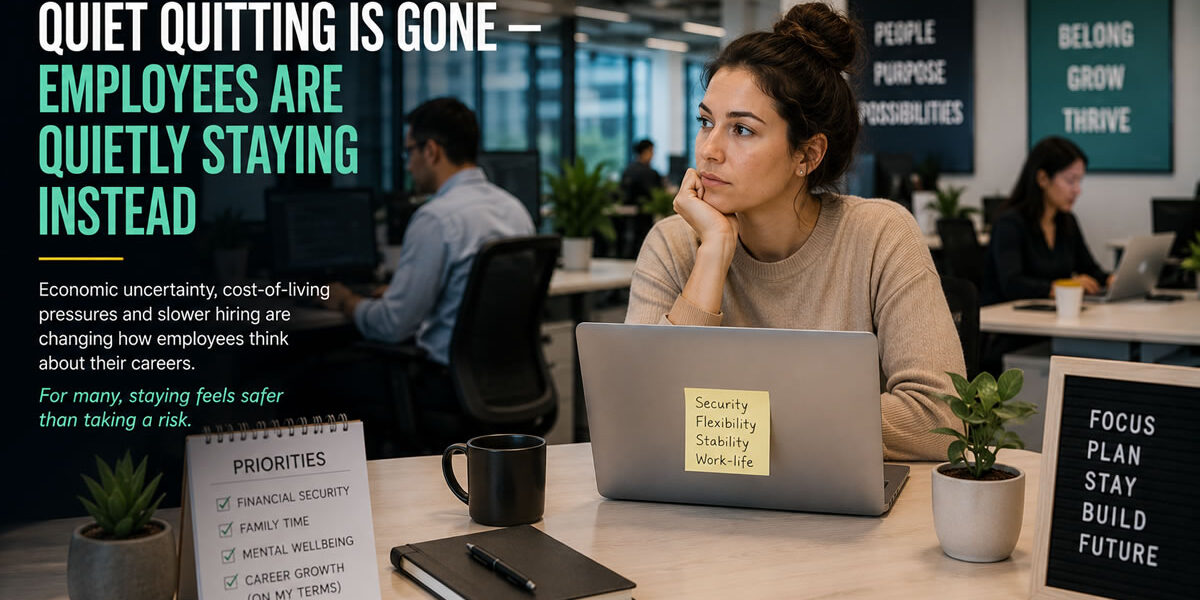
For several years, workplace conversations were dominated by phrases like “quiet quitting,” the “Great Resignation,” and employee disengagement. Employers worried about staff leaving in large numbers, reduced loyalty, and changing workforce expectations following the pandemic years.
But a different workplace trend is now beginning to emerge.
Employees are not necessarily quitting.
Increasingly, many appear to be staying — quietly, cautiously, and often without confidence in the broader job market.
Across multiple industries, economic uncertainty, cost-of-living pressures, housing affordability concerns, and slower hiring conditions are reshaping workforce behaviour. Employees who may once have considered changing employers are instead becoming more reluctant to take career risks, even where dissatisfaction exists.
For HR teams, this creates a new and more subtle challenge.
Retention figures alone may no longer provide a reliable picture of workforce engagement.
An employee who stays is not automatically an employee who is motivated, optimistic, or committed long-term. Some organisations are beginning to observe what could best be described as “quiet staying” — employees remaining in roles largely because external uncertainty feels greater than internal frustration.
This creates a potentially misleading sense of workforce stability.
On the surface, turnover may appear lower. Yet underneath, organisations may still face disengagement, reduced morale, lower innovation, and growing emotional fatigue among employees who feel professionally stuck.
The trend is also changing workplace dynamics in other ways.
Employees are increasingly prioritising security, flexibility, predictable income, and work-life stability over aggressive career progression. At the same time, many employers continue pushing for higher productivity, office attendance, and faster adaptation to technological change.
The result is a workforce that often appears compliant externally while privately reassessing long-term career confidence and trust in employers.
For HR leaders, this means engagement strategies may require a significant rethink.
Traditional retention metrics may no longer tell the full story. Increasingly, organisations may need to focus less on whether employees are leaving and more on whether employees still feel connected, valued, and optimistic about their future inside the organisation.
Because an employee staying physically present does not always mean they are fully engaged psychologically.
And in today’s economic environment, quiet staying may become just as important for employers to understand as quiet quitting ever was.
This article was published by HR-INFO, Australia’s long-standing human resources and workplace information resource.