


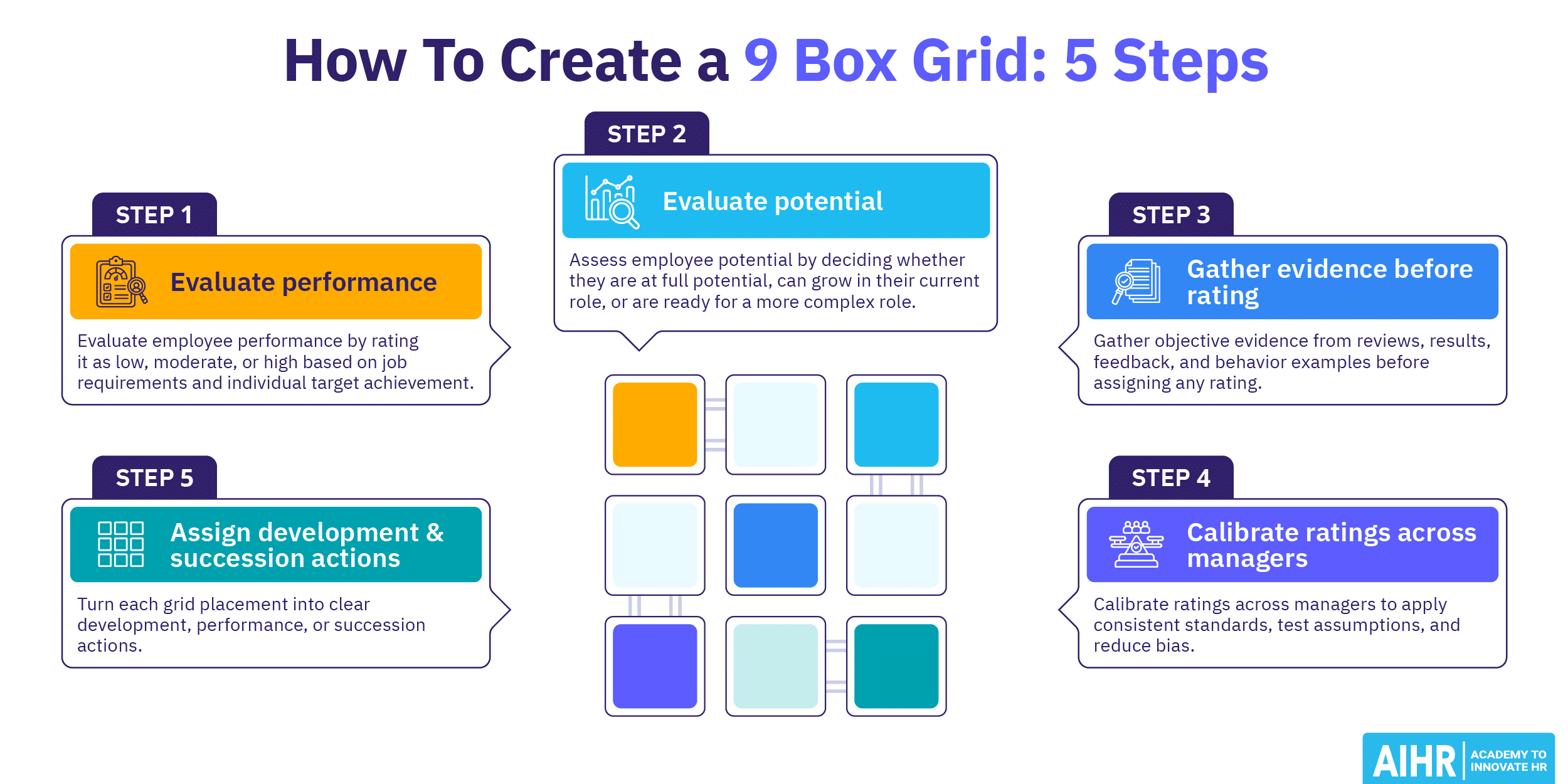
Guidance adapted from aihr.com.
AIHR’s practitioner guide describes how HR teams and managers can use the 9-box grid to structure talent reviews, development decisions and succession planning. The grid compares employees’ current performance with their assessed potential for future growth, but its placement should prompt discussion and action—not become a fixed label.
Build ratings on evidence
Assess performance against role requirements and relevant goals, and define what low, moderate and high performance mean in your organization. Potential is harder to judge consistently, so gather evidence such as appraisal results, business outcomes, 360-degree feedback and examples of learning, adaptability or leadership behaviour. Avoid relying on a manager’s impression alone.
During a talent review, managers can present their assessments while HR or senior leaders help calibrate ratings across teams. Challenge assumptions, ask for evidence and align on shared definitions. This can help reveal inconsistent standards and patterns of bias.
Turn placement into follow-up
Use each placement to agree development or support, rather than treating the grid as an outcome in itself. Depending on the employee’s circumstances, actions might include mentoring, stretch assignments, role clarification, targeted skills development or performance support. High performance and high potential may inform succession discussions, but should not be treated as a promise of promotion: opportunities depend on business needs and available roles.
Record the reasoning behind ratings and the actions agreed. Revisit placements over time—for example, every six to 12 months—and track progress rather than treating the assessment as permanent.
Keep context in view
AIHR cautions that a two-dimensional grid can oversimplify performance and potential. Role complexity, tenure, skills, motivation, resources and personal circumstances may affect an assessment. A low rating, for instance, may reflect unclear expectations or inadequate support rather than a lack of ability. Clear communication and deeper discussion can help reduce the risk of the grid becoming a forced-ranking exercise or limiting someone’s future opportunities.
The guide also describes alternatives for different questions: a Skill Will Matrix can support task-specific coaching, while talent cards can capture an individual’s skills, experience and career interests. These approaches can complement the grid by adding context to development discussions.
Original Source: https://www.aihr.com/blog/9-box-grid/